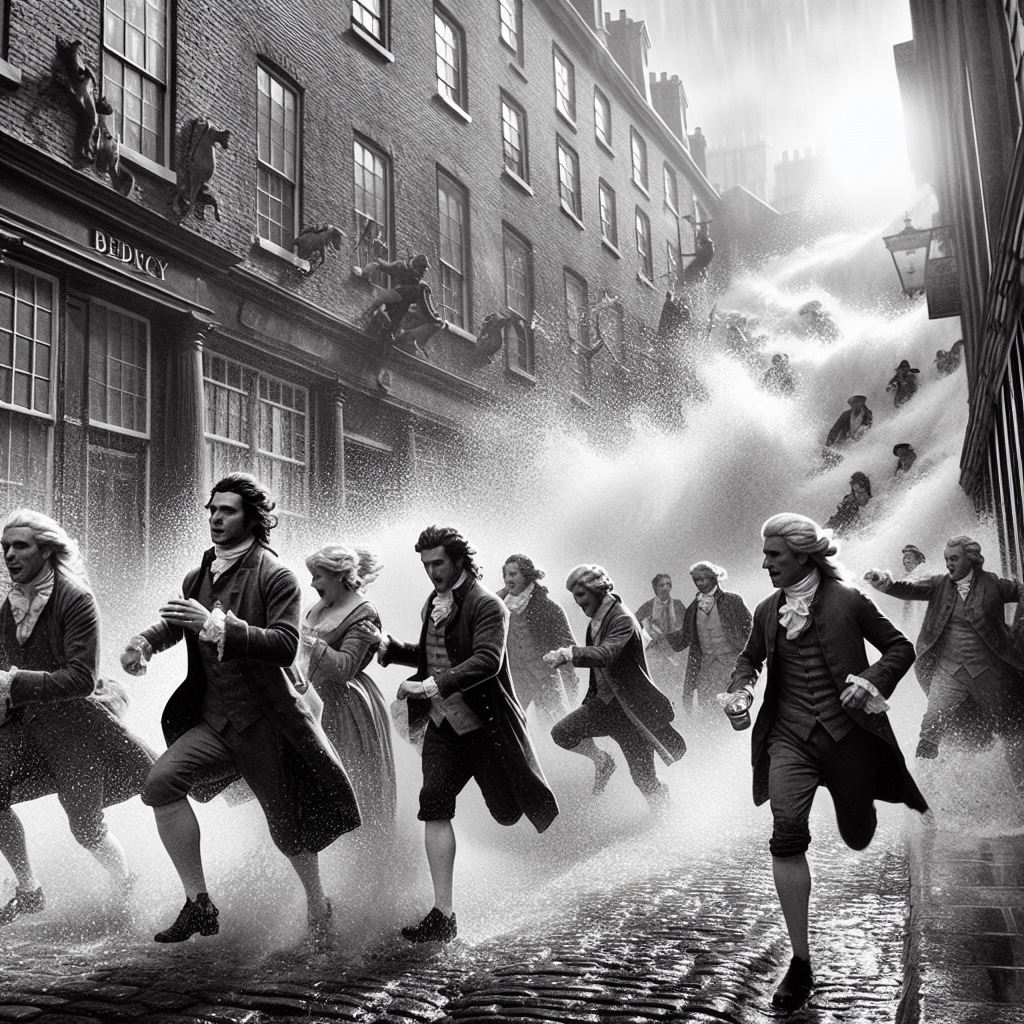
Imagine a tsunami of beer flooding through the streets of London drowning people in its path. Sounds implausible? Yet this is exactly what happened on October 17, 1814. A terrible accident led to a tidal wave of booze crashing through the city centre, sweeping away everything in its path.
Today, the Dominion Theatre stands on Tottenham Court Road, near the junction with Oxford Street. Go back a hundred years and that site was occupied by the Horseshoe Brewery, owned by Meux & Co. It had been located there since the year 1764. The brewery was dominated by an immense twenty-two feet high vat – an enormous wooden barrel held together by metal hoops. Over time, those hoops had corroded and on the fateful day of October 17, 1814, the vat exploded. It damaged another vat, which also emptied its contents.
The volume of beer released totalled 7,600 imperial barrels. One imperial barrel is 36 gallons. So, we’re talking about over 273,000 gallons of beer gushing out of the brewery. This frothy brown tide moved forward with surprising force engulfing neighbouring properties.
Right next to the brewery was a sprawling warren of squalid slums known as the St Giles Rookery. No trace of it remains today as the Victorians, later in the 19th century, redeveloped the whole area, widening roads and demolishing rickety houses. But in 1814, the rookery took the full brunt of the beer tsunami.
Two houses were immediately demolished. Tragically, the beer poured into the many basement tenements resulting in fatalities. One family was holding a wake for a child who had died previously – before succumbing themselves to this flood of alcohol. The beer carried large chunks of timber which increased the destruction.
How many died may ever be known. Children wandered the streets looking for their parents. From contemporary newspaper reports, we know the names of those bodies identified. Eleanor Cooper was fourteen years old. Mary Mulvey was a 30-year-old married woman. Hannah Banfield was just four while Ann Saville was sixty.
The inquiry afterwards found that brewery inspectors had seen the hoops around the vat were damaged but decided to take no action – not long before the vat exploded. It was filled up to four inches of the top, so maximum capacity. There were gruesome tales in the newspapers afterwards detailing how the bodies of those drowned were found.
DISCOVER: Ten places in London where hangings used to take place
So what were the consequences for the owners – the Meux family? Well, this was Georgian England – so there were no consequences. Henry Meux was the son of the founder of the Meux brewing business and owned the Horseshoe Brewery. Six years later he was made a baronet.
If you’re looking for karma, you’ll find it in the fate of the next generation. Henry Meux’s son was fabulously wealth and elected as a member of parliament. But in 1858, a “commission of lunacy” declared that Meux was unfit to continue in parliament – his insanity more than likely a result of syphilis.
The Horseshoe Brewery continued to operate in central London until the 1920s. In 1921, the beer making was relocated to another Meux site in south London. By the end of the decade, this familiar landmark was demolished and part of the site was taken up by the Dominion Theatre. The site of what was once the rookery is now occupied by the Centre Point tower block, the shops and offices on Charing Cross Road, and a London Underground station.